
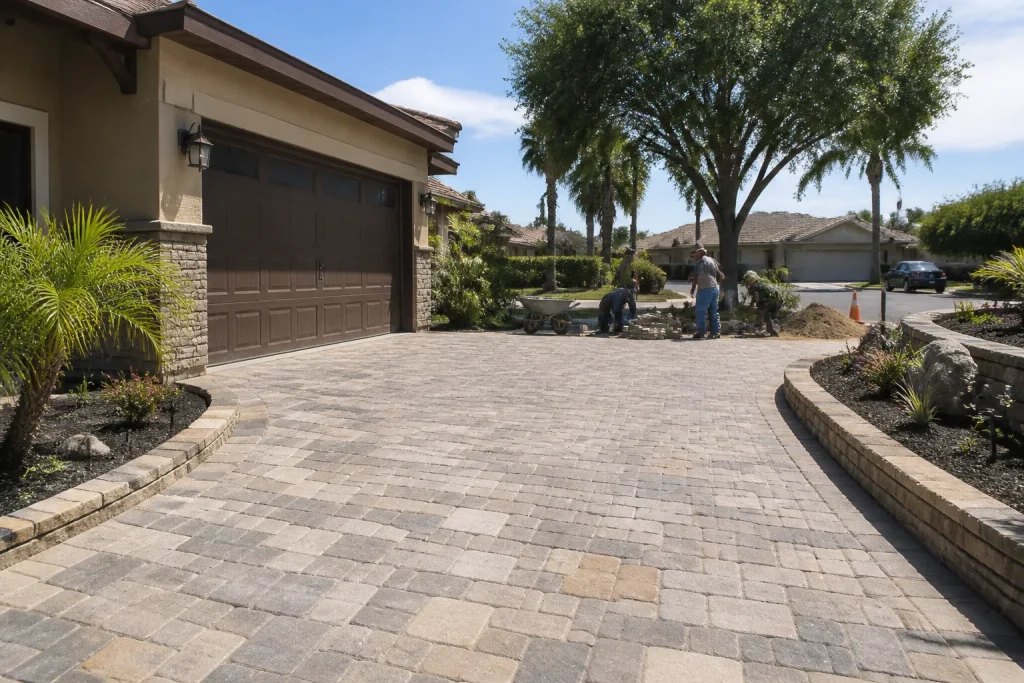
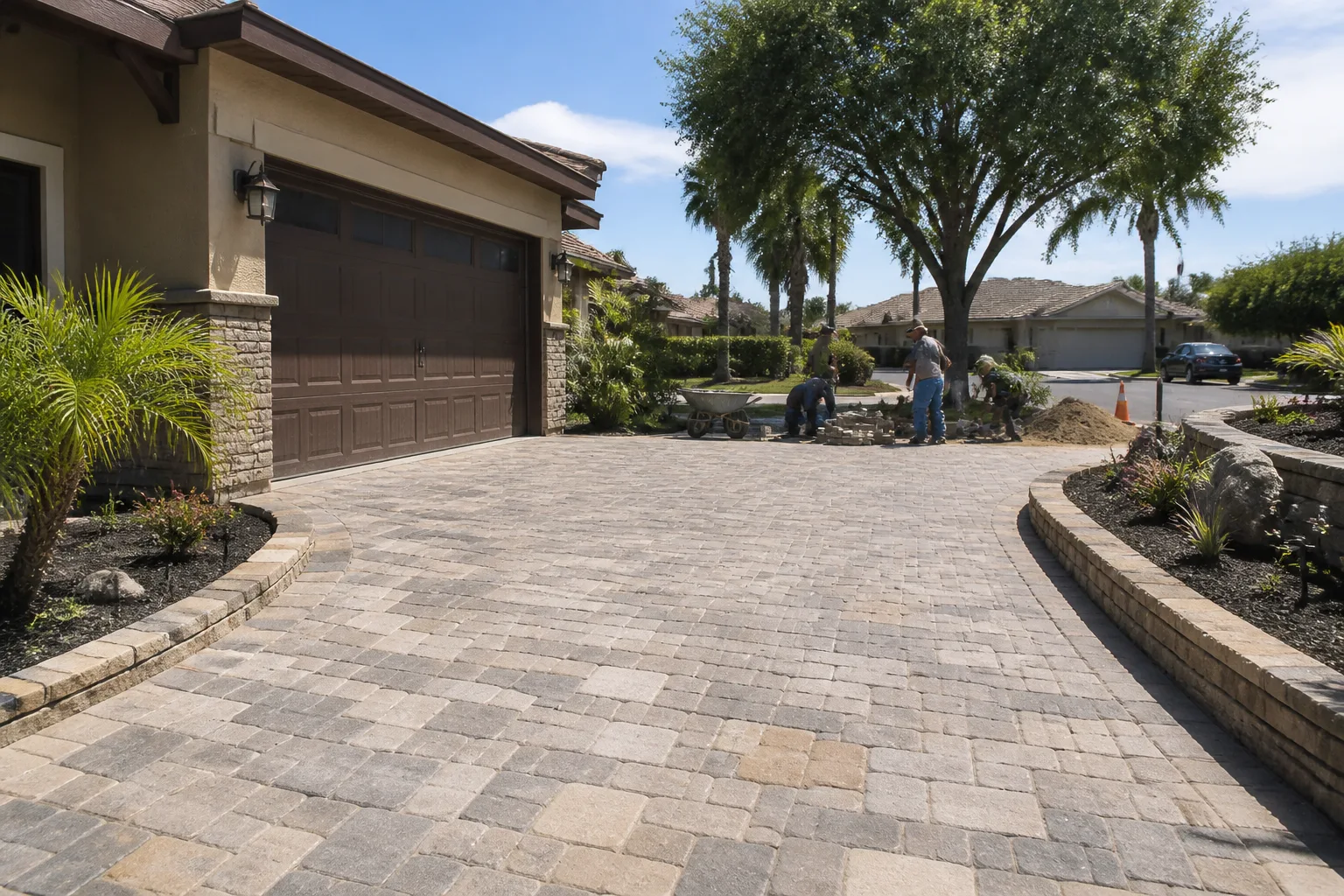
Driveway & Pavers Near Me: How to Choose a Local Construction Company in Fullerton
A five-star review tells you the contractor was pleasant and finished on time. It tells you nothing about whether the base under your pavers will hold for 15 years, and the base is the only thing that really matters with a driveway. The right way to pick a paver crew in Fullerton is to qualify them before you ever compare bids: verify the license, ask how they build the base, and read the contract clauses that separate a driveway contractor from a handyman with a plate compactor. Here’s the checklist we’d want if we were hiring this out. And if you’d rather not spend a weekend doing that homework, call (844) 834-8322 and we’ll walk you through it.
What license does a driveway contractor need in Fullerton, and how do you check it?
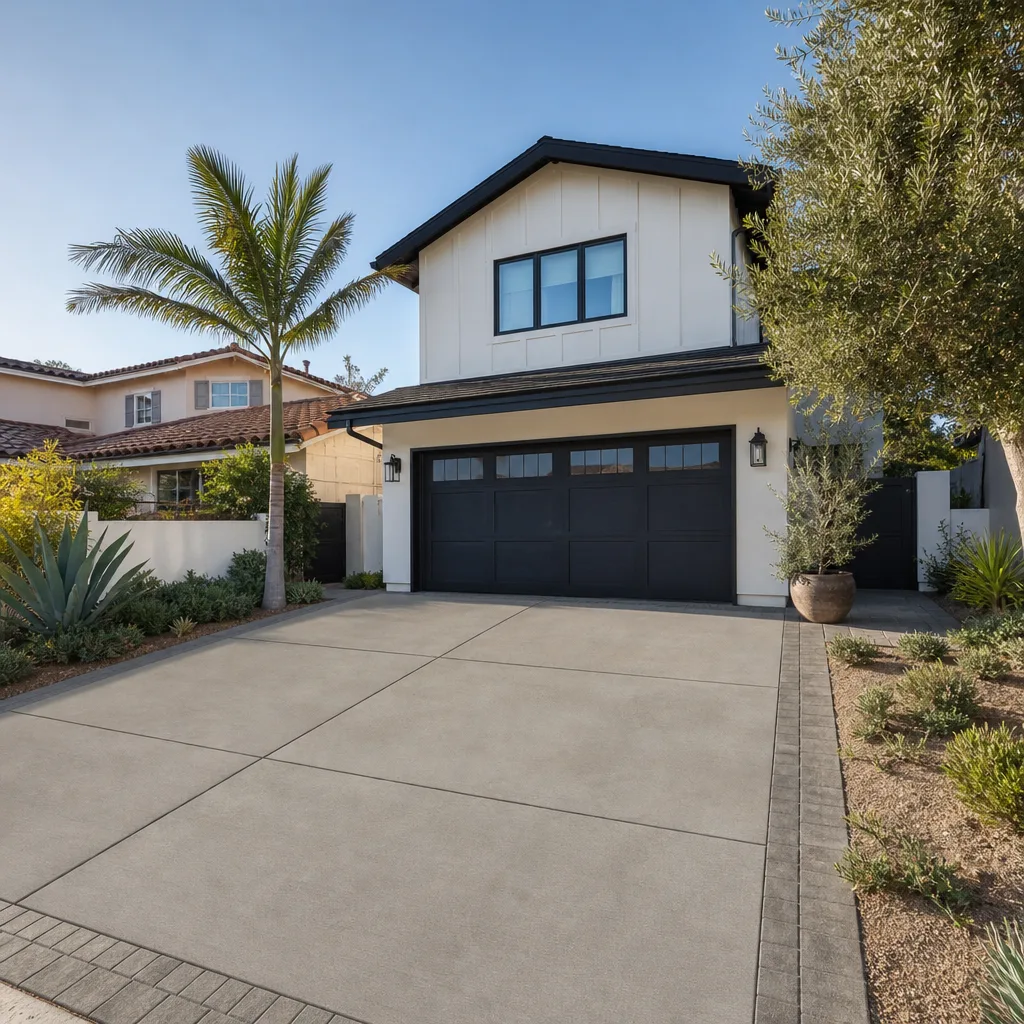
You want a contractor holding a valid California license in a classification that covers hardscape and driveway work, and you can confirm it at the Contractors State License Board (CSLB) website in about two minutes. Pull up the license number and check four things: the classification matches the work, the license is active and in good standing, the business name matches who’s quoting you, and the license covers the trade you’re hiring for. A driveway is a structural surface tied to grading and drainage, not a decorative add-on, so the classification on the license should make sense for that scope.
Two-minute CSLB check, in order:
- Ask for the license number before the estimator arrives. A legitimate contractor has it memorized.
- Search it on the CSLB site and confirm the status reads active.
- Check the classification against the scope: driveway, hardscape, and site work in one package.
- Confirm the name on the license matches the name on your bid and the contract.
- Ask whether the contractor carries general liability and workers’ compensation, and ask to see the certificates.
Why this comes first: a crew without the right classification can’t legally pull the permit for work that needs one, and paving a driveway usually triggers permit and inspection questions in Fullerton. Unpermitted hardscape can create a headache when you sell the house. Our technicians have up to 14 years of experience, and we’d rather lose a job than see a homeowner pay twice.
What should you ask about base preparation before accepting any bid?
Ask how deep the base goes, what material they use, and how they compact it, then listen closely to the answer. If a bidder can’t tell you the base depth, the aggregate type, and how compaction is verified, that’s your answer. The pavers are the visible part, but the base is what stops settling, rutting, and edge shifting a few seasons down the road.
A crew that builds driveways to last will talk about excavation depth, a compacted aggregate base like a Quikrete or Sakrete stabilized base or an Oldcastle aggregate, a proper geotextile separator, and edge restraint that’s set into a concrete collar rather than spiked into loose soil. They’ll tell you the joints get filled with polymeric sand and mention how the surface drains away from the garage and toward the street or a drainage point. When we quote a driveway in Fullerton, the base and drainage conversation comes before the paver selection.
Red flags worth walking away from:
- A bid that’s a lump sum with no line items and no base specification.
- “We’ll just lay them over the existing surface.” Pavers over failed concrete or dirt fail fast.
- No mention of edge restraint or the joint sand holding everything tight.
- A salesperson who can name ten paver colors but can’t tell you the base depth.
Why does material sourcing transparency beat brand name-dropping?
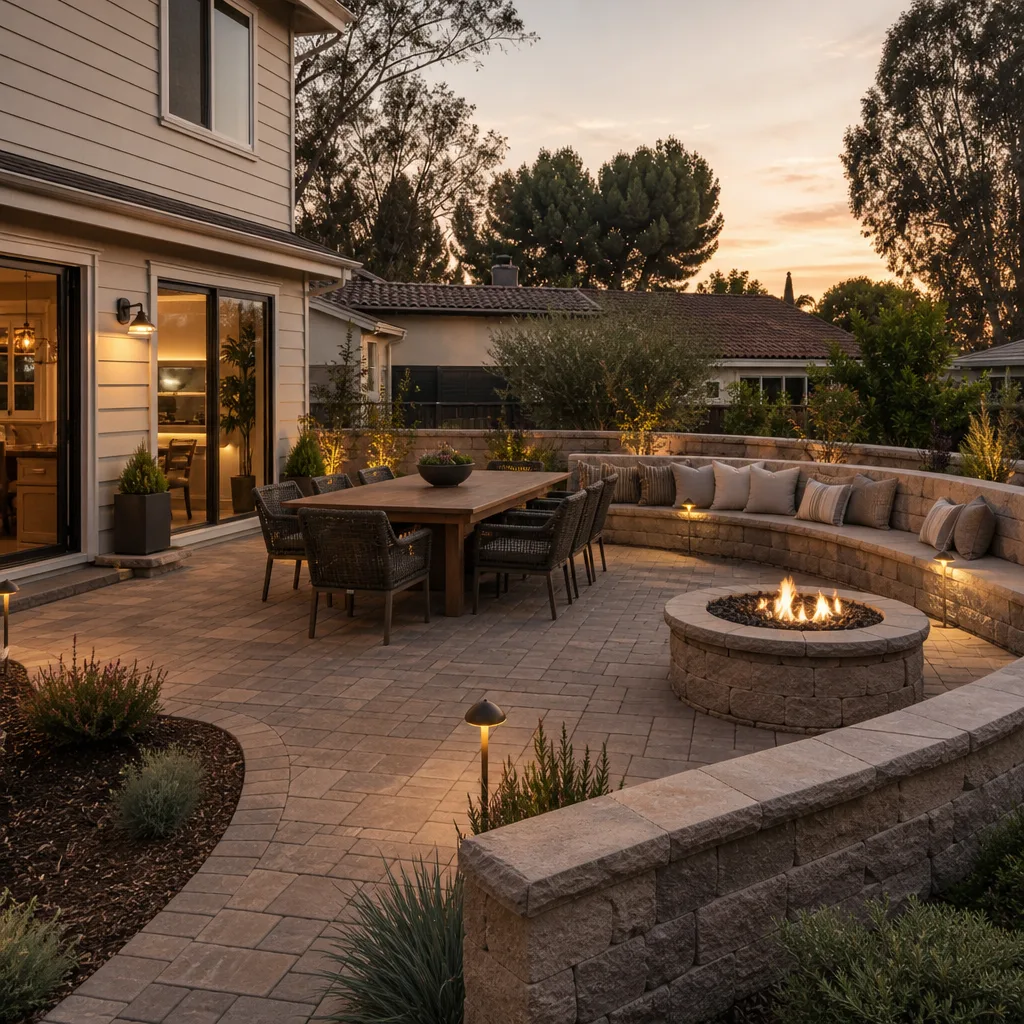
A contractor who names Belgard, Cambridge Pavers, and Techo-Bloc on the first call earns a little credit, but transparency is the bigger test. Ask exactly which paver line, thickness, and color they’re specifying, and get it written into the bid. The sales conversation is easy to fill with brand names; the contract is where the real product lives. When a homeowner has chosen Cambridge Pavers, the bid should say Cambridge Pavers, with the SKU or product name, not “premium pavers.”
The bait-and-switch risk with driveway work is real. Bids go out on a name-brand unit, then a substitution shows up on site with a story about a supply delay. That substitution changes the color, the dimensional consistency, and sometimes the compressive rating of the paver itself. We specify the manufacturer in writing and don’t sub in unknowns. You choose the brand, we handle the build. If a model isn’t available, that’s a conversation before the first paver is laid, not after.
What to ask about materials, in plain terms:
- Which manufacturer and which product line, specifically?
- What thickness are the pavers, and is that a driveway or a walkway spec?
- Which joint sand and which edge restraint, and are those named in the bid?
- If a product is out of stock, what’s the substitution policy, in writing?
How do you evaluate a completed project in person instead of from photos?
Go look at a finished driveway in Fullerton with your own eyes and, ideally, an entire wet season behind it. Portfolio photos crop out the failures. A real driveway tells you the truth at the joints, the edges, and the transitions. Walk the surface and check the joints between pavers for consistent width and full sand fill. Look down the plane of the driveway for the “birdbaths” where water pools. Run your eye along the edge restraint and see whether the pavers sit tight against it or gap and walk. Then check the transition at the garage slab and at the street apron, which is where a sloppy install shows itself.
What a solid install should look like in person:
- Joints: uniform, snug, and filled with polymeric sand that’s cured hard, not washed out.
- Edges: restraint locked in and hidden, no pavers wandering out toward the grass.
- Transitions: no lip up to the garage apron, no step down to the sidewalk, drainage flowing the way it should.
- Surface: flat to the eye with no low spots holding water and no ridge lines where a base was uneven.
Ask the contractor for a project they finished a full year or more ago and go stand on it. Any honest driveway contractor will have one ready. If you’re planning this as part of a larger exterior refresh, our driveway & pavers work is where the base-and-drainage conversation starts.
Which contract clauses separate a professional driveway contractor from a handyman?

A professional driveway contract is a short, plain document with a few non-negotiable clauses, and it reads like a plan rather than a promise. The scope is itemized: excavation, base depth, geotextile, edge restraint, paver brand and line, joint sand, and cleanup. The scope matches the bid line for line. That’s the baseline. What separates the pros is the rest of the paperwork.
Look for these clauses before you sign:
- Written, itemized scope that names the materials, quantities, and base specification.
- A payment schedule with a modest deposit and progress payments tied to completed milestones. A large upfront cash request is a warning.
- A change-order clause that requires written, signed approval for any scope or material change, with a stated price.
- A clear statement on permits: who pulls them and who pays the fee, and that inspections pass before final payment.
- A workmanship warranty, in writing, that states the term and what’s covered.
- Lien-waiver or lien-release language so subcontractors and suppliers are paid and can’t come after your property.
- A completion and cleanup clause that sets expectations for the site.
If a contractor resists putting any of that in writing, that’s the sorting test. The verbal handshake crowd is not the crowd you want building the base under your driveway.
When to call a pro
Most driveway and hardscape projects in Fullerton are worth handing to a licensed contractor, but a few situations make it a clear call: a driveway that holds water, sunken or heaved sections, an existing surface that’s cracked through the slab, or a project that touches grading and drainage near the garage or the street. Those are structural problems. Laying pavers over a failed base burns money twice.
For a broader look at what we handle beyond the curb, see Construction Fullerton. If the paving project runs alongside a fence repair or a bigger exterior plan, our fence installation and home additions & ADU teams work the same property, so the phases line up instead of fighting each other.
Related services in Fullerton
- Driveway & pavers installation, base, edge restraint, and drainage
- Fence installation coordinated with hardscape work
- Home additions & ADU if the driveway project is part of a larger build
The Bottom Line
Picking a driveway contractor in Fullerton comes down to four things: a license you’ve verified on the CSLB, a base preparation plan you understand, materials named in writing, and a contract that protects you. Reviews and price alone won’t tell you whether the base will hold for 15 years, and the base is where the money goes. Walk a finished driveway in person. Read the clauses. Ask the boring questions about compaction and edge restraint, and hire the person who answers without flinching.
If you’re in Fullerton and need help, Construction Fullerton offers free estimates. You’ll get a written, line-item quote, and the written estimate sets the final price, with no change orders unless you approve them in writing. Call (844) 834-8322. We answer 24/7. Fast dispatch from 7am to 7pm, Sunday through Friday.
Frequently Asked Questions
Paver driveway pricing runs per square foot and depends on the base depth, the paver line, the edge restraint, and the drainage plan. Because the spec drives the price, we don’t quote from a phone call. Call (844) 834-8322 for a free, itemized estimate on your specific driveway; the written estimate sets the final price.
Go to the Contractors State License Board (CSLB) website and search the license number. Confirm the status is active, the classification covers hardscape and driveway work, and the name on the license matches the name on your bid. Two minutes, free, and it can save you a five-figure mistake. If you’re already talking to us, we’ll provide the number on request.
Sometimes, but only if the existing slab is sound and the new base and drainage are handled correctly; a failing slab is a demolition-first job. A contractor who proposes laying over cracked or heaved concrete without checking it is skipping the step that keeps pavers flat. Ask exactly what happens to the existing surface, in writing.
Most residential driveways run a handful of working days once materials are on site, with the timeline shaped by square footage, base depth, and drainage work. Weather and permit or inspection timing can shift it. Call (844) 834-8322 for a free estimate and a realistic schedule for your property.
Written by the team at Construction Fullerton.
Need Construction Help?
Call Construction Fullerton - licensed & insured, here with fast help in Fullerton.
(844) 834-8322